
One connected campus. A resilient network built for every building.
Oglacs designed a campus-wide network infrastructure for Al-Karim University, replacing fragmented connectivity with a redundant fiber backbone, managed switching, extensive Wi-Fi coverage and centralized perimeter security across a 60+ acre campus.
Campus connectivity had grown in fragments.
As the university expanded across separate academic, administrative and residential buildings, connectivity depended on ad hoc links and independently managed equipment. The result was an uneven network experience and a growing burden on the team responsible for keeping it running.
Independent devices and inconsistent capacity
Unmanaged Wi-Fi routers and non-standard network devices operated independently, with different DSL connections shared across buildings and limited signal distribution within many spaces.
Hostels and doctors’ quarters left behind
Residential areas did not have reliable internet connectivity, creating a gap between the university’s campus footprint and the connectivity available to its occupants.
Slow links, packet drops and outages
Multiple isolated networks and uneven capacity contributed to slow performance, packet loss and frequent interruptions—making everyday digital services less dependable.
Complex troubleshooting across the campus
With devices managed separately and no consistent network architecture, administrators faced additional effort to locate faults, troubleshoot connectivity and maintain service across dispersed buildings.
A resilient backbone with managed distribution and campus-wide access.
The design places a redundant fiber backbone at the center of the campus network. Core and distribution layers connect the data center to building networks, while managed access switching and centrally governed Wi-Fi extend service to academic, administrative, clinical and residential spaces.
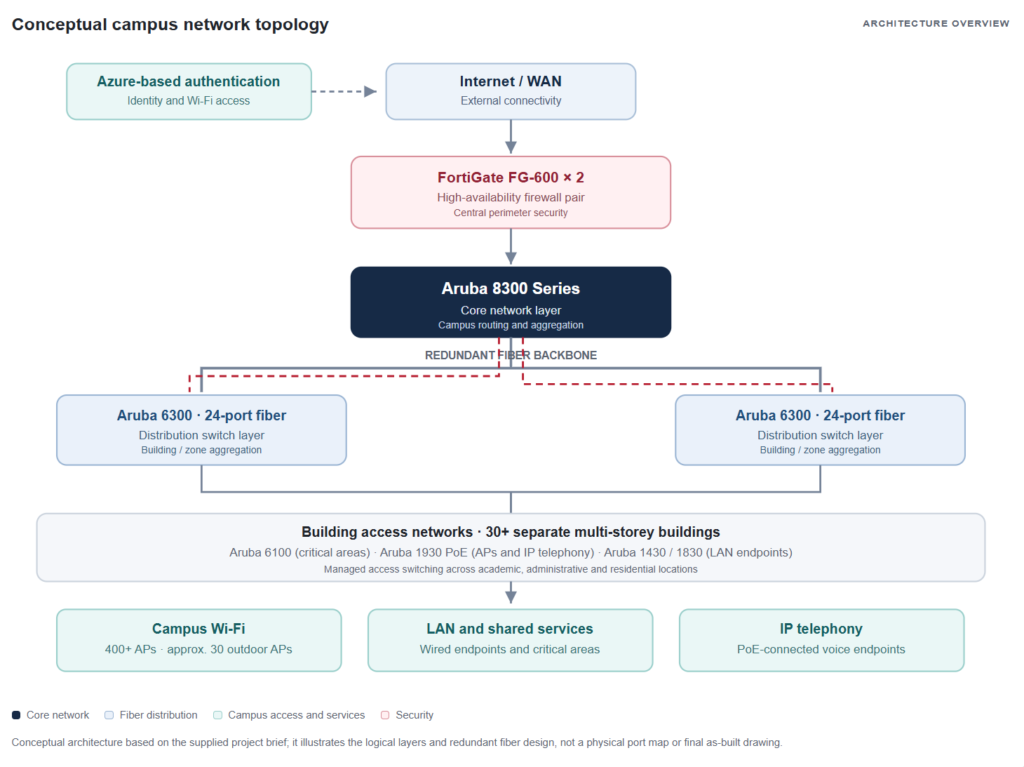
Designed for scale, resilience and simpler operations.
A layered network architecture standardizes how buildings connect, how traffic is distributed and how users reach services—while enabling centrally managed wireless access and a high-availability security perimeter.
Redundant campus fiber
Fiber backbone links connect buildings back to the data center and distribution layer over redundant paths, reducing dependence on isolated, building-by-building connectivity.
Enterprise core and distribution
Aruba 8300 Series core networking and Aruba 6300 24-port fiber distribution switches provide a structured backbone for campus-wide traffic aggregation.
Fit-for-purpose access switching
Aruba 6100 switches serve critical areas; Aruba 1930 PoE switches connect wireless access points and IP telephony; Aruba 1430 and 1830 switches connect general LAN devices.
Campus-wide Wi-Fi coverage
More than 400 access points, including approximately 30 outdoor APs, extend wireless access across buildings and outdoor areas, including hostels and doctors’ quarters.
High-availability perimeter security
A pair of FortiGate FG-600 firewalls configured for high availability provides a centralized security layer between the campus network and external connectivity.
Identity-aware wireless access
Azure-based authentication supports visitor access, sponsored guest access and role-based SSIDs, helping align wireless access with different user categories.
From fragmented links to a managed campus network.
The delivered portfolio establishes a broader digital foundation for publishing information, handling applications, connecting professional registration processes and supporting regulatory review.
Connect buildings
Establish redundant fiber connectivity between the data center, distribution points and campus buildings.
Centralize traffic
Deploy a defined core layer to aggregate and route campus network traffic.
Standardize uplinks
Connect building and zone networks through fiber distribution switches.
Extend coverage
Provide managed wired, wireless and PoE connectivity for users and devices.
Govern access
Apply high-availability firewalling and role-based wireless authentication.
Designed for scale, resilience and simpler operations.
A layered network architecture standardizes how buildings connect, how traffic is distributed and how users reach services—while enabling centrally managed wireless access and a high-availability security perimeter.
What changed: a defined fiber backbone, standardized network layers, broad wireless coverage and centralized security and authentication replaced the previous model of disconnected devices and independently shared internet links.
- Connectivity gaps across separate campus buildings
- Unmanaged routers and inconsistent network capacity
- Slow connectivity, packet drops and frequent outages
- Limited connectivity in hostels and doctors’ quarters
- High troubleshooting and administration overhead
- Wireless access needs for staff, students, visitors and sponsored guests
Campus scale, supported by a layered design.
60+ acres
University campus footprint
30+ buildings
Separate multi-storey facilities
400+ APs
Campus wireless access points
~30 outdoor APs
Wireless coverage in outdoor areas
Reliable connectivity starts with a network designed as one system.
We help institutions replace fragmented connectivity with structured, secure and scalable network infrastructure—planned around real buildings, real users and the operational needs of the organization.